The Hierophant and Five of Swords Tarot Combination
Free · One card a day · No credit card needed
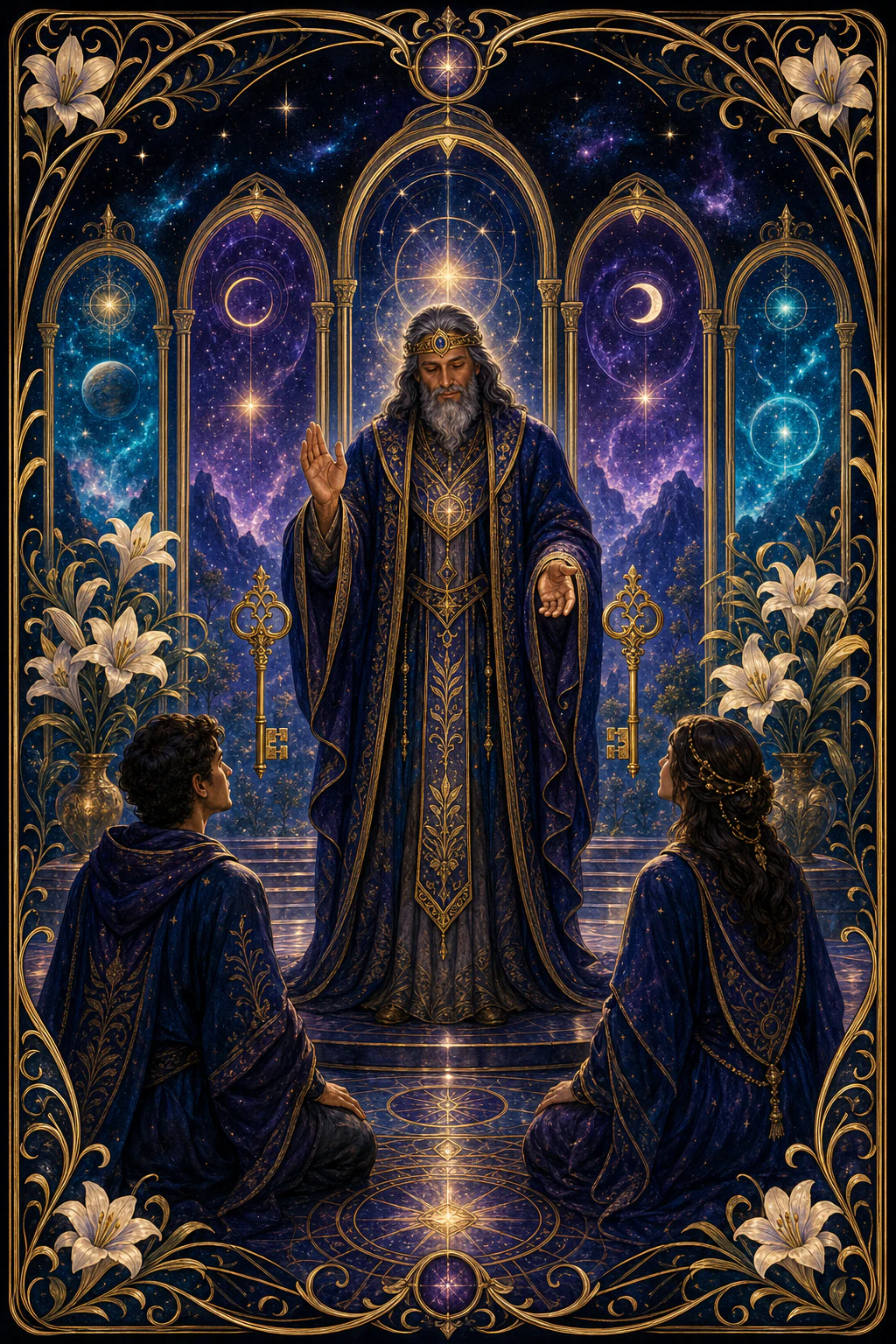
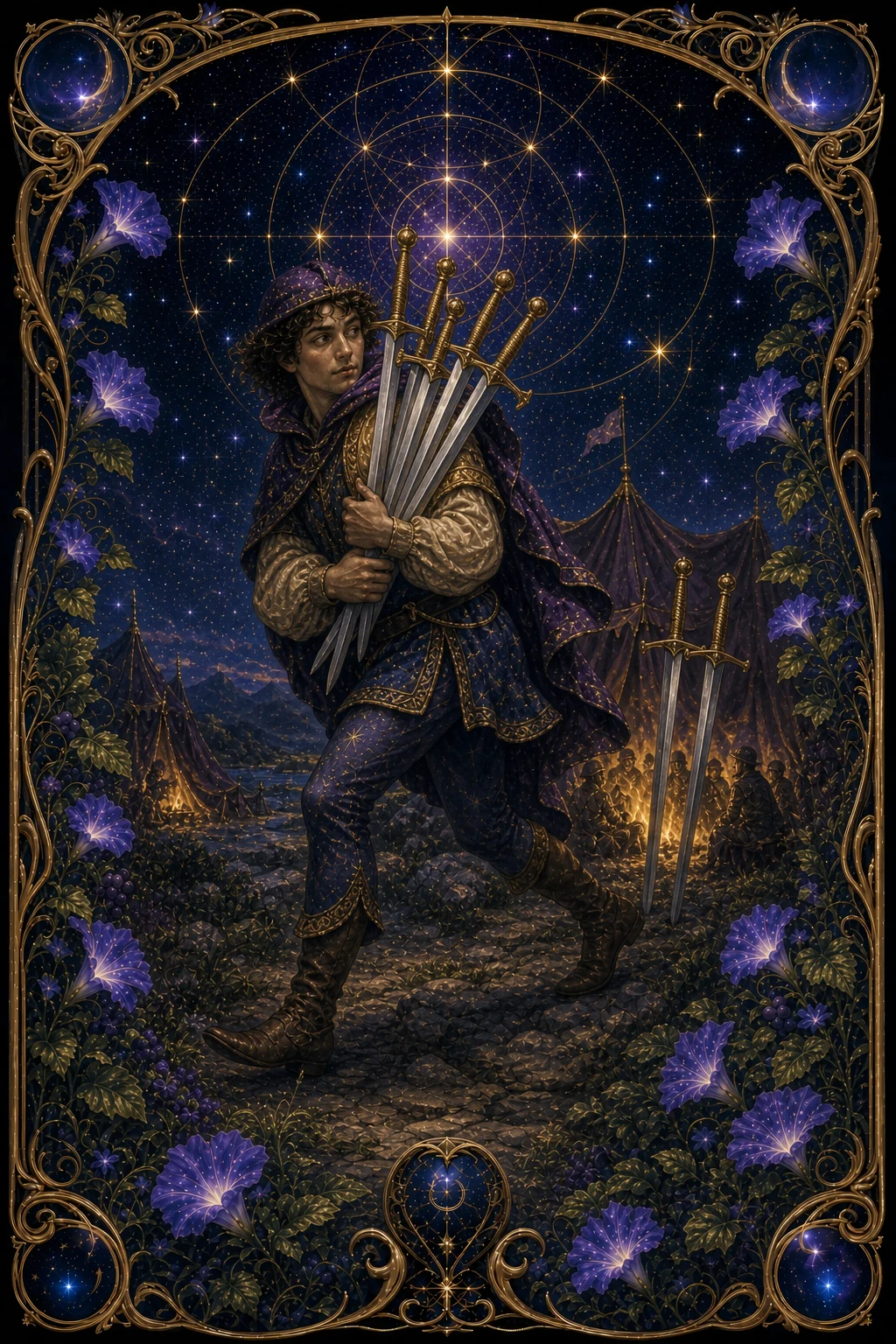
Every major arcana card dreams of being relevant, and every minor arcana card is relevance itself — which is why they pair so well. The Hierophant supplies the tradition that gives the pairing weight (tradition, conformity, morality, ethics); Five of Swords supplies the thought that gives it an address (conflict, victory, tension, departure). Weight without an address is just heaviness. This pair has both.
The combination
In this pairing the cards have different jobs and they know it. The Hierophant holds the meaning — tradition, tradition, conformity, morality, ethics — while Five of Swords holds the assignment: thought, conflict, victory, tension, departure, due now. Do not meditate on the major card and postpone the minor one; the spread has already done the meditating for you. The work is the small card, and the large card is there to tell you why the small work matters. Air and earth are the odd couple — the abstract and the concrete. The Hierophant thinks in tradition; Five of Swords insists on thought. The combination works when the idea agrees to touch the ground.
In love and relationships
Between people, this card raises shared frameworks: the agreed shape a connection takes, whether that shape was inherited from your families, borrowed from friends, or assembled without discussion. Between people who care about each other, this card sits with the disagreements that are technically resolved and emotionally not.
This pairing often appears when a relationship is at an inflection point that feelings alone cannot settle. The Hierophant brings tradition into view (tradition, conformity, morality, ethics); Five of Swords brings thought (conflict, victory, tension, departure). The cards are not describing what will happen between two people — they are describing what is already true and waiting to be acknowledged. Start there.
In work and purpose
In work and study, this figure stands for qualification, apprenticeship, and the slow business of being taught by someone better than you. In working life, this card is the deck's note about the meeting you won.
Work readings with this pair often surface the gap between capacity and arrangement. The Hierophant's tradition (tradition, conformity, morality, ethics) and Five of Swords's thought (conflict, victory, tension, departure) are both real; the friction is in how they are currently combined. Consider which of your capabilities is underused because the structure around it was built for an earlier version of you.
When one or both are reversed
Reversals here ask for the quieter reading. Where the upright pair acts outwardly on tradition and thought, the reversed version points at the inner forms of those things — tradition, conformity, morality, ethics and conflict, victory, tension, departure as unfinished business rather than events. If The Hierophant is the reversed card, the tradition in question may be something you have not admitted to wanting. If Five of Swords, the thought may be arriving in disguise. Either way, the work is interior before it is practical.
Yes or no?
Not as asked
The cards pull opposite ways — one affirms, one refuses. Read this as: not in the form you imagined it.
Asked of the pair together, the cards answer as a unit rather than voting separately. The Hierophant on its own leans one way and Five of Swords another; the combination's verdict above is the synthesis, and the note attached is worth sitting with longer than the verdict itself.
The cards in this combination
- The Hierophant — Spiritual wisdom, religious beliefs, conformity, and tradition.
- Five of Swords — Conflict, hollow victory, tension, and walking away.
Related combinations
- The Emperor and The Hierophant tarot combination
- The Hierophant and The Lovers tarot combination
- Four of Swords and Five of Swords tarot combination
- Five of Swords and Six of Swords tarot combination
- All 2,772 minor arcana combinations
Journal prompts
- What are you passing on without meaning to?
- What kind of disagreement do you reliably enter, and what is it usually standing in for?
- If you had to explain this combination — tradition meeting thought — to a friend over tea, what story from your own life would you tell?
Curious what The Hierophant and Five of Swords mean for your question? Turn a card on the home page — no account needed.
Draw a card freeOne card, one honest question, most evenings.
Start your free daily readingFree · One card a day · No credit card needed
Go deeper than one card
A personalized deep reading works a full spread around your question — The Hierophant and Five of Swords included, if it falls to you. Deep readings run from the $1.99 Single Card Illumination and the $7 Three-Card Path, delivered straight away, to the $19 Five-Card Compass and the $29 Celtic Cross Atlas, composed in depth and delivered within 2–4 hours.
The $29 Celtic Cross Atlas, ten cards read position by position → · All reading options →
Prefer a rhythm to a one-off? Sparkle Pro ($8.99/month or $59/year) draws a three-card past, present and future spread for you every day. There is also a free eight-phase moon ritual guide to pair with today's card.
To sit with this card longer, the tarot journaling guide has prompt sets for daily draws, moon phases, and more.
Tarot content is for entertainment and personal reflection, not professional advice.